Thursday, February 7, 2013

Bookbinding 101: Book Cloth

Let's be honest. 

The first time I was told to pick out a book cloth to bind a book, I thought, Why would anyone want their handmade book to look like it came from a public library? 

That was back when I had a limited knowledge of book cloth. 

Let's be honest again. 

I still don't know very much about book cloth. However, I have come to appreciate it a bit more since my first experience in binding with it several years ago.  Here's my limited knowledge for you:

1  Library book cloth is often called Library Buckram. It's a very heavy cotton cloth that has been treated to resist dirt, water, oils and wear. It's thick and sometimes comes shiny. I have a sheet of burgundy library buckram and it sort of feels plasticky. Buckram can still be beautiful. When it is not (and if you ask me it usually isn't), it is pretty much because it doesn't care to be, as its first purpose is to protect. But still, it can have its moments of beauty. 

 I like working with book cloth that has been backed with paper. You can buy starched bookcloth without the paperback. However, it's nice to have the paper backing on it so you don't have to worry about any glue coming through the fabric. If you buy a starched, nonpaper backed piece of book cloth, I recommend using wheat paste with it instead of PVA. The wheat paste won't (it could, but most likely won't) stain the fabric like PVA would if it happens to soak through. 

 I love Japanese Book Cloth. Especially the natural linen. It's not actually natural linen, they just call it that. The "natural linen" Japanese book cloth is actually Rayon. It looks like linen and is very similar to its natural cousin but it's really a synthetic rayon. The cover on the right in the photo shows the Natural Linen Japanese Book Cloth in action. It's beautiful and simple and I absolutely adore the texture and feel. It's expensive, but I feel like it is totally worth its price. 

Covers made by Amy Spencer at our Los Angeles Book Arts
Workshop, May 2012, during the Raised and Inset Designs class.
Left board is lambskin and the right board is Natural Linen
Japanese Book Cloth. 
4  I also like Italian Book Cloth (Cialux). It's backed and comes in a variety of beautiful colors.

5  We had a custom order for a couple of silk covered books. We used silk duponi, which we first backed with paper as discussed in point eight below. The idea behind using this silk for the cover was that it would look old and worn by the time the artist was finished drawing in the book because the silk would wear very quickly. I wish I had "after" photos of these, but here are the "before" photos: 


Silk won't hold up on books very well, but for its purpose with these, I'm sure it did its job wonderfully, aging the covers quickly.

6  Black book cloth is very difficult to work with and keep nice. It shows everything. So if you are picking out book cloth for the first time. Don't choose black. 

7  Did I mention I love Japanese Book Cloth? Here's another example:
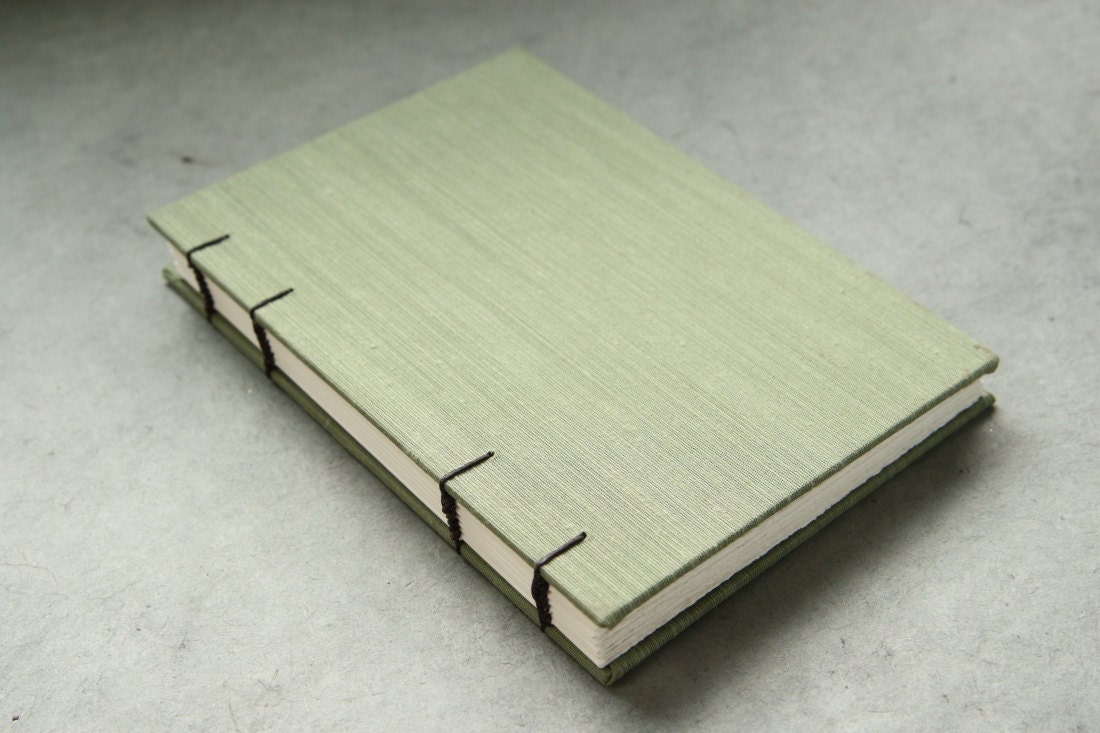
Click here to see more about this book.

8 You can make your own bookcloth. There are two ways. One is more traditional, and you can make it at archival pH levels so as to make your books last longer. This way involves using wheat paste, pasting the fabric onto washi or kozo. The other way is to use Heat n' Bond or Wonder Under, first ironing it to the fabric, then ironing the now glue backed fabric to washi or another type of thin paper. Kristin Crane has a how-to-make-bookcloth tutorial. Worth a look if you have a fabric you'd love to use to cover your book.

I'm still learning about book cloth. If you'd love to share your knowledge or experience using it please  leave a comment.

Monday, February 4, 2013

Bookbinding 101: Rice Paper and Mull

Rice paper and mull are used to strengthen the spine of a book.


Mull is a net-like, woven linen or cotton fabric (linen is stronger than cotton) that's been treated with a starch to stiffen and strengthen it. Mull is also called "Super" and "Crash" and "Tarlatan". The mull is glued onto the spine of certain book structures to aid in strengthening the spine, and, when overlapping the spine, also helps strengthen the endpapers in the hinge part where they attach to the book board. If this doesn't make sense now, it will in future tutorials where we show it being used in constructing a book (see photo of spines with mull below). Mull can be substituted with natural, unbleached, undyed muslin.


Rice paper is very thin. Almost tissue paper thin. However, it's also extremely strong for how thin it is, and can be used the same way mull is, but on smaller or lighter books. Mull is thicker than rice paper, and we use it for heavier or larger books, but rice paper has been outstanding for 4" x 6" and smaller books. It's especially great for miniature books when the thicker mull would be too bulky.


The bottom book has mull that overlaps the spine, which in this case,
will be used to attach the book board covers, helping, along with the endpaper,
to strengthen the hinge of the cover. The top book, a cord bound,
has mull glued down to just the spine without overlapping.

Anything to add to the discussion? Please leave a comment.

Monday, January 21, 2013

Bookbinding 101: Adhesives

For most of our bookmaking involving glue [edit: to be clear, not all our books are made with glue], we use Jade 403 PVA (poly-vinyl acetate).

Jade 403 PVA
  • Thick and can be thinned to desired consistency
  • Dries Fast, but . . .
  • . . . Can be mixed with wheat paste or methyl cellulose to create a slower drying time
  • Does not yellow over time
  • Strong
  • pH neutral, acid free
  • Can be heat activated, so it can be heated after it dries to make it tacky again
  • Water soluble when wet, permanent when dry
  • Transparent
  • Flexible

This can't be shipped during cold weather because it's ruined if it freezes. So stock up in the late summer or early autumn. We usually get ours from Hollander's.

You can also use standard bookbinding PVA sold through many different brands and stores. However, the high archival characteristics of Jade 403 have been well tested for and that's why it's highly used. I've found that standard PVA glues are thinner than Jade 403. Not that the standard PVA's are bad, and I certainly am not recommending against using them, but I like the more sure longevity Jade 403 has due to the testing it has received, and I also like the thickness of it. Hollander's also has a thicker version of the standard PVA.

Wheat Starch Paste: Great for backing cloth with paper, gluing material to book board covers (paper, book cloth or leather), and for gluing thin papers together. If I were gluing two pieces of tissue paper together, I'd use wheat paste instead of PVA, being both thinner and more gel-like rather than watery, and watery is what thinned/watered down PVA would be like.  Also available at Hollander's.
  • Very thin
  • Dries slowly allowing for repositioning or longer working time
  • Strong bond 
  • Acidic, not pH neutral but sodium carbonate can be added for buffering
  • comes in powder form that you add distilled water to and cook, there's also a non-cooking kind
  • Can be stored for many years in it's dry powder form. Make enough to use for the project on hand. 
  • Once mixed, it can be stored in refrigerator for a few days. Although, best to use when freshly mixed.
Rice Starch Paste is great too. I haven't really used this but other binder's seem to like it just as much as wheat paste.

Methyl Cellulose

Often used by book conservationists, sometimes to fix a break in a book. Being somewhat weak, it is preferred that the book would break in the same place rather than another place, which would be more likely if using a stronger adhesive.
  • Can also be used to clean off old glue from books. I don't know how, but have read it can be.
  • Not very strong on it's own so it's helpful in book repair or for gluing things that you don't want to have a strong bond.
  • Not best to use on its own if you want a strong bond
  • Dries Clear
  • Reversible in cold water
  • Acid Free and pH neutral


EVA Emulsion 
(not hot glue sticks but emulsion which is used sort of like PVA)

We have not tried EVA emulsion but there is an article on the Book Arts List Serv written by David Amstell on this type of glue and it seems to work quite well for many bookbinders.

You can read more about EVA here.


The Do-Nots:   Elmer's glue, glue sticks, spray adhesive
Why not? Even though Elmer's glue is a form of PVA (there are different kinds of PVA), it takes forever to dry, yellows when it ages, and can sometimes be brittle when dry. Same with glue sticks. Spray adhesive is often not pH neutral, it's brittle when dry and can create air bubbles in paper, and sometimes does not stick nicely with book board.

Thursday, November 29, 2012

30 by 30

I turned 29 yesterday. I remember my parents turning thirty. Thirty in my mind has always meant: Adult. 

Gulp. 

I have one year left before I'm officially an adult. So what am I going to do in that year? Here's my Thirty Things to Do before I Turn Thirty:

(they are in no particular order of importance, just a random list of things I'd like to do)


  1. Give five handmade gifts away (not for any special occasion, but just because)
  2. Take another out-of-state trip with Daniel
  3. Start a photo album of our family -- (we make albums and Daniel is a photographer. You'd think we'd have one started already, right?)
  4. Teach an Online Class -- (Will you be attending?)
  5. Hiking trip overnighter with Daniel and the boys. 
  6. Finish a landscape painting. 
  7. Create a self-portrait.
  8. Girl's day out with Mom, and Sisters. This has to be the whole works: shopping, lunch, pedicures, movie. Seriously. So. Excited. For this.
  9. Strengthen my voice. I lost it last May teaching a week of workshops in Los Angeles. It's never been the same.
  10. Read the Standard Works again. (This includes the Holy Bible, Book of Mormon, Doctrine and Covenants, and Pearl of Great Price.)
  11. Printmaking with the boys. Jadon has been persistent about asking to do this. I love that.
  12. Buy a Car. We have never owned a vehicle. I think it's time.
  13. Teach a free class open to the whole community. 
  14. Watch a foreign film with Daniel. (we use to do this often, I'd like to start doing this again.) 
  15. Take the boys bowling.
  16. Create a new set of one-of-a-kind monotype prints (12-15)
  17. Organize and decorate every room in our apartment.
  18. Replace the eye glasses I lost a few years ago. I'll be needing them to drive at night.
  19. Visit the zoo with my boys.
  20. Learn to play 5 hymns on the piano.
  21. Enter 3 juried art shows within the year
  22. Attend the temple monthly for one year 
  23. Finish a quilt (one of the many already started)
  24. Finish my kids Halloween costumes at least 2 weeks before Halloween
  25. Finish my 100 artist books in one year project (finished date is set for Oct 1, 2013)
  26. Reach blog post #300. This post is #185. Please leave comments. They motivate me.
  27. New family photos taken
  28. Take another class or workshop in relation to bookbinding. I'm always learning. It's a must.
  29. Learn to meditate. 
  30. Write 10 letters to my children to give to them at some far future date. 

I can do this. I can be an adult.

Saturday, November 10, 2012

Secret Belgian Binding Workshop

The 10 book workshop in Logan was going to be the last bookbinding class I taught this year, but upon request, I'll be teaching a couple more before this year is through.

The Secret Belgian Binding Workshop
November 30th, 2012
5:30 pm - 9pm
201 West Center Street, Provo, UT
The studio above Provo Art & Frame


There are five Secret Belgian Binding Books in this photo
(the rest are coptic). These Coptic Stitch and Secret Belgian Binding
Books are from the workshop in Los Angeles back in
May of this year (2012). I love the combinations
of decorative papers that my students used.  

The Secret Belgian Binding has a look similar to a Japanese Stab Bound
but it's a hardbound book that will open really nice with pages
that lay flat.

This binding works well for any purpose: journaling, sketchbooks,
guestbooks, photo albums... it really is a very versatile book and we
discuss the different materials you can use for this book in the
Secret Belgian Binding workshop.

The workshop is November 30th which is a Friday Night. Is Friday night your date night? Bring your husband or wife and they get a $10 discount.

Students need to bring the following tools but all other materials/tools are provided. We bring our stash of papers from around the world for you to choose from . . . you'll love it!

Tool list (all my students get a discount at Provo Art & Frame, just ask for a discount card at the checkout):

Pencil
Scissors
Bonefolder 
Bookbinding Awl 
Xacto Type Craft Knife
Cutting Mat
Metal Edged Ruler
Glue Brush (we recommend a 1" flat brush)